
Industrial Coolant Lines and Common Failure Points with Leak Prevention
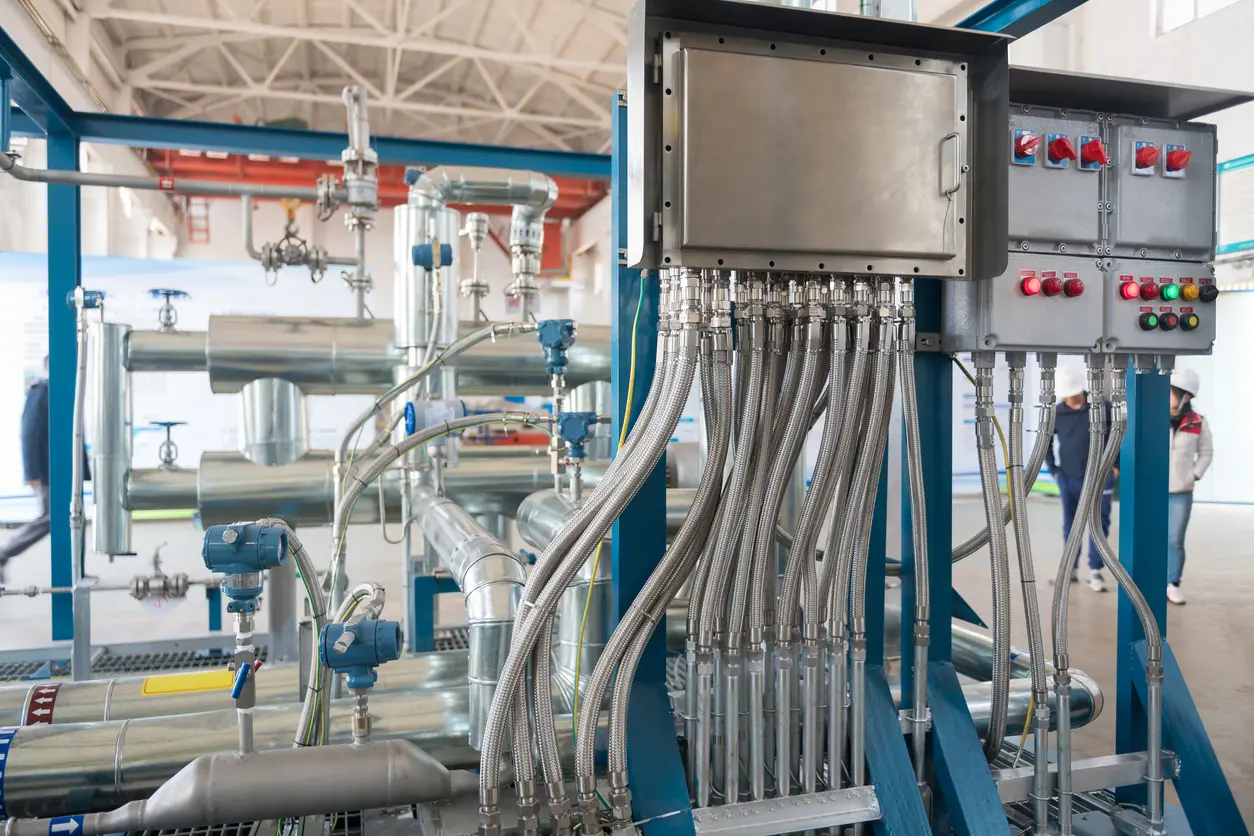
Industrial coolant lines aren’t prone to defects, and leaks are certainly one of them. While the causes range, it’s critical to note that most leaks occur at connections, flex points, abrasion zones, and thermally stressed sections.
RB Royal details common failure points of industrial coolant lines, including leak-prone areas, and how proper maintenance intervals can prevent coolant line failures.
Where Coolant Lines Fail
| Failure Point | Common Cause | Warning Sign | Prevention Method |
|---|---|---|---|
| Hose to fitting joints | Loose or too tight, corroded, wrong style clamps | Dampness or dried coolant residue at the joint | Use specified constant torque or spring clamps and correct hose/fitting sizes |
| Threaded fittings | Damaged threads, incompatible thread forms, inadequate/excessive sealing | Weeping at threads, pressure decay | Standardize thread types, favor face seal or O-ring designs where possible |
| Quick disconnects | Worn O-rings, contamination, misalignment | Drips immediately after coupling/uncoupling | Select coolant-compatible seals, cap ports during service |
| Hose bends and flex zones | Insufficient bend radius, repeated motion | Flattening, surface cracks, stiffness | Respect minimum bend radius, use formed hose or tube, and add bend support |
| Abrasion points | Contact with brackets, sheet metal, sharp edges | Polished spots, frayed braid, worn outer cover | Reroute lines, add clamps, and edge protection |
| Heat exposed sections | Temperature cycling, radiant heat, excessive coolant temperature | Hardening, discoloration, cracking | Select hose and tube and seals for operating |
| Corroded metal tube or fittings | Incompatible coolant chemistry, galvanic couples | Pitting, rust, green/white deposits, thinning | Maintain coolant chemistry, avoid dissimilar metal couples |
| Welded or brazed joints | Poor joint preparation, incomplete penetration, thermal distortion | Circumferential staining, crack at heat impacted zone | Qualify joining procedure, inspect joints, and provide strain relief |
| Expansion joints and rigid pipe interfaces | Thermal expansion constrained by rigid supports | Leaks at flanges and fittings after thermal cycles | Design for thermal growth, use guides and anchors correctly |
| Tube to tube fittings | Incorrect tube prep, burrs, wrong insertion depth | Drips at ferrule fitting | Cut square, deburr, clean, mark insertion depth |
| Manifolds, valves, pumps, and heat exchangers | Gasket/O-ring aging, cavitation, vibration | Drips around housings, fluctuating pressure and flow | Service seals, maintain adequate suction conditions |
| Machine enclosures and drains | Blocked return screens, clogged chip conveyors | Coolant pooling, overflow at seams | Clean screens and return paths, inspect covers, verify sump capacity |
Main Causes Behind Leaks
Coolant lines can leak for multiple different reasons, and it’s important to note that leaks are a type of failure, not the only one as noted above. Vibrations and cyclic fatigue are the first common cause behind leaks in coolant lines. When pumps or engine vibration and pulsating pressure loads back off threaded joints, leaks can be introduced into a system.
Temperature and pressure cycling is another cause of leaks as heat changes dimensions while pressure loads joints and hose reinforcement. If a rigid line is too constrained, thermal growth transfers into a fitting or another part of the line.
Perhaps the most common cause for leaks are assembly errors. In many cases, leaks originate during fabrication or service from poorly cut tube ends, burrs, contaminated O-rings, reused seal, or other improper materials.
Recommended Maintenance Practices
Performing routine maintenance on industrial coolant lines not only is a cost-effective measure in comparison to replacing them, but it promotes product longevity. A recommended maintenance plan could look something like the chart below.
| Interval | Recommend Maintenance Activity |
|---|---|
| Daily | Check coolant levels, pressure or flow alarms, visible joints, floor conditions, and any signs of pooling or misting |
| Weekly | Walk down high-risk joints, quick disconnects, pump seals, filters, strainers, bulkhead fittings, and abrasion points to view any abnormalities |
| Monthly | Inspect clamps, supports, bend zones, insulation, hose condition, return screens, drain paths, and coolant cleanliness |
| Scheduled coolant service interval | Test coolant concentration, pH, inhibitor condition, contamination levels, then flush or replace according to system requirements |
| Annual or outage based | Replace old hoses, seals, O-rings, and any quick disconnect service kits |
Are Your Industrial Coolant Lines Failing You? Contact RB Royal Today
RB Royal are industry experts in designing, engineering, manufacturing, and testing custom fluid transfer system components including hoses, tubes, and hardlines. For nearly 85 years, our team has partnered with OEMs, supplier programs, and other customer sources for high-quality manufacturing programs.
We’re able to design multiple variations of any fluid transfer component through our design-ufacturing program. From there, we begin prototyping and manufacturing operations and move into product testing to ensure reliability and part verification.
Are you experiencing issues with your industrial coolant lines? Contact RB Royal today for more information on our manufacturing programs and see the difference we can make for you.